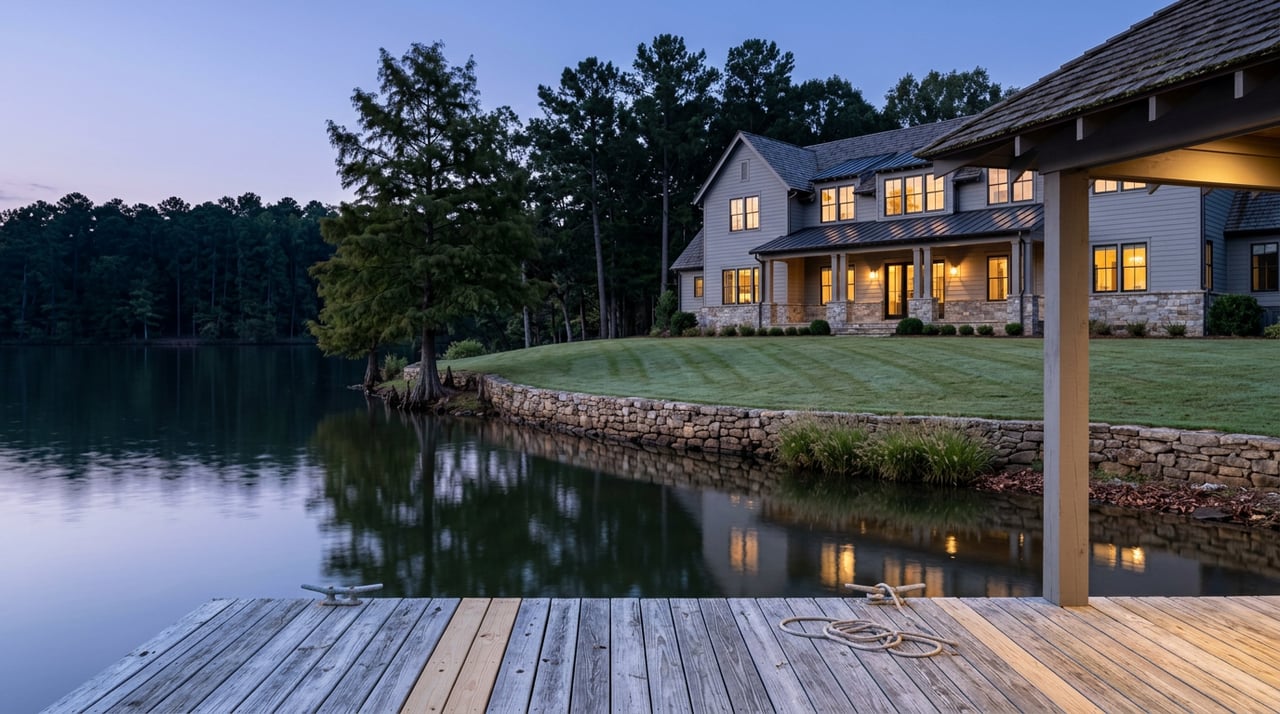
Walk any listing tour on Lake Hamilton this year and the dock does the selling. The covered boat slip on Long Island Drive. The double-stall lift tucked into a cove off Emerald Isle. The weathered platform at a Caroline Acres cottage that a stager has dressed with two Adirondack chairs and a coil of rope, as if to say: this is what you're really buying. And in a market where homes are sitting longer than they used to, that photo matters more than ever. Lake Hamilton's median sale price ran $414,752 over the three months ending May 2026, down 7.5 percent from the same stretch a year earlier, and the typical home was taking 101 days to sell, up from 87 days the year before. A softer market means sellers lean harder on the water to close the gap. The dock is the argument.
Here is the part that doesn't show up in the listing photo. That dock isn't part of the house in any legal sense. It sits on land Entergy Arkansas has owned and managed since it built Carpenter Dam and flooded the Ouachita River valley in 1932. The house is yours the moment you close. The dock is a separate, revocable permission that has to be re-issued to you by name, and it does not happen automatically just because a deed changed hands.
The Permit Doesn't Follow the Deed
Every private dock, boat lift, seawall, and boardwalk on Lake Hamilton and Lake Catherine sits inside Entergy's hydroelectric project boundary, not on a homeowner's private lot in the way a detached garage would. Entergy states plainly that all project lands or water require a permit from the company before anything is installed or placed there. That single sentence is the whole relationship in miniature: the water is Entergy's, the shoreline structures on it are Entergy's to license, and a permit is only ever valid for the person and the facility named on it.
That last clause is what catches buyers off guard. Since a policy that took effect January 1, 2018, Entergy has required a condition-based inspection of any single-family dock, swim deck, or boardwalk before its permit can transfer to a new owner. The utility built the requirement after realizing that buyers were closing on lakefront homes only to discover, months later, that the dock had electrical faults, structural rot, or signage violations the previous owner had never disclosed and never fixed. The inspection has to be done by an Arkansas-licensed home inspector who has completed Entergy's own training, and the report goes to Entergy, not just to the buyer. If the inspector finds deficiencies, someone has to correct them before the permit moves to your name. Whether that someone is the seller before closing or you after it is entirely a matter of what you negotiate into the contract, not something Entergy decides for you.
"All project lands or water require a permit from Entergy Arkansas prior to installation or placement."
That is Entergy's own framing, and it means the dock you're touring on a Saturday afternoon is, until the paperwork clears, still legally the seller's problem to solve or yours to inherit.
Why the Frontage Rule Splits the Market in Two
Two houses on the same cove can look like the same purchase and carry completely different dock rights, depending on one date: January 1, 2006. Entergy currently requires 75 feet of shoreline frontage before a lot qualifies for a boat dock. But any property platted before that date is grandfathered in at the old standard of 45 feet. A buyer comparing a 1990s subdivision lot in Oak Shores against a newer parcel a few coves over needs to ask when the lot was platted, because that answer determines whether a storm-damaged or worn-out dock can be rebuilt at all, or only in a smaller footprint, or not at all if the current owner already used up the grandfathered allowance on a larger structure than a new 45-foot lot would otherwise support.
Depth matters just as much as width. Entergy also requires 7 feet of water at the end of the dock ramp, a rule put in place specifically to cut down on the number of docks that have to be relocated every year during the drawdown. Lake Hamilton's routine winter drawdown begins November 1 and the lake typically refills starting in early March, reaching summer pool by mid-March. A dock that looks perfectly functional in July can be sitting over mud by January, and a lot that can't clear the 7-foot standard at its shallowest point may not support a dock upgrade even if the frontage math works.
None of this is disclosed by a listing photo. It's disclosed by a plat map, a permit history, and a phone call to Entergy's shoreline management office, which is exactly why it belongs in due diligence rather than in the "nice to have" column.
The Lake Next Door Isn't the Same Deal
Hot Springs area guides and vacation rental sites routinely bundle Lake Hamilton, Lake Catherine, and Lake Ouachita together as interchangeable versions of "the lake." They are not. Lake Ouachita's shoreline sits inside the Ouachita National Forest and is managed by the U.S. Army Corps of Engineers, not Entergy, and that distinction changes what you can actually own. Private lakefront home ownership with a personal dock is essentially unavailable on Lake Ouachita. The occasional mobile home offered for sale in one of the lake's resort communities does not come with the land beneath it, let alone a private dock permit. If a buyer's mental map of "lakefront near Hot Springs" includes Ouachita as an option for the same kind of house-plus-dock purchase they'd make on Hamilton, that map is wrong, and it's wrong in a way that only surfaces after someone has already spent a weekend touring properties that were never going to work the way they imagined.
| Lake Hamilton / Lake Catherine | Lake Ouachita | |
|---|---|---|
| Managing entity | Entergy Arkansas (hydroelectric project) | U.S. Army Corps of Engineers |
| Shoreline land | Entergy project boundary | Ouachita National Forest |
| Private dock ownership | Permitted, tied to platted frontage | Effectively unavailable to private buyers |
| Typical lakefront housing stock | Single-family homes, condos, gated communities | Rare mobile homes in resort areas, no land ownership |
This is the part a Little Rock or Hot Springs shopper rarely hears from a listing sheet, because the sheet is written to sell a feeling, not to explain federal land jurisdiction.
What a Slower Market Actually Buys You
The softening median price and the longer days on market aren't just numbers for a seller's pricing conversation. They change who holds the leverage when a dock permit needs work. In a fast market, a buyer who asks for an Entergy inspection and remediation before closing risks losing the house to someone who won't ask. At 101 days on market, that risk drops. Sellers with a home that's been sitting have more reason to complete the inspection, fix what it finds, and hand over a clean permit transfer rather than lose another buyer to the same question three weeks later.
That's the leverage worth using. Before writing an offer on a Lake Hamilton or Lake Catherine property with a dock, ask the seller or listing agent for:
- A copy of the existing Entergy permit, confirmed to be in the current owner's name
- The most recent condition-based facilities inspection report, if one exists
- As-built drawings or a survey showing the dock's location relative to the high-water mark
- Confirmation of the lot's original plat date, to establish whether the 45-foot or 75-foot frontage rule applies
If the seller can't produce these, that's not a reason to walk away. It's a reason to build time and an inspection contingency into the contract, and to make clear in writing who pays if the report finds something that needs fixing before the permit can move.
Frequently Asked Questions
Does a Lake Hamilton dock permit transfer automatically when the house sells? No. Entergy requires a condition-based inspection of the dock, swim deck, or boardwalk before the permit can be reissued in the buyer's name, a policy in place since January 1, 2018. The house closes on your timeline. The dock permit moves on Entergy's.
If my lot only has 45 feet of frontage, can I ever build a bigger dock? Not without losing the grandfathered status. The 45-foot allowance applies only to lots platted before January 1, 2006 and only preserves what already exists. Any request to expand triggers review under the current 75-foot standard.
Is a home near Lake Ouachita a substitute if I want lakefront with a private dock? Generally, no. Lake Ouachita's shoreline is federal National Forest land managed by the Corps of Engineers, and private dock ownership tied to a residential lot is essentially not part of that market the way it is on Hamilton or Catherine.
The dock is often the reason a buyer falls for a Lake Hamilton listing. Just don't assume it's the reason the deal closes cleanly. If you're comparing waterfront properties across Hot Springs and want someone who checks the permit history before you fall in love with the view, Capital SIR can walk the shoreline paperwork with you before you write the offer. Schedule a complimentary market consultation and we'll start with the questions the listing photo doesn't answer.